My book is officially “in production,” which means that the content is more-or-less finalised and I’ve turned everything I have over to the magicians at Minnesota Press. I can’t wait to share the cover art (it’s still with the artists!) alongside all kinds of behind-the-scenes stories throughout the whole process.
The official title is Singing with Invisible Worlds: Fermenting Sake on Microbial Time. In recent talks, I’d been using the provisional title “ongoing song” as a nod to how the brewers used song to measure time for certain fermentation steps. I like the switch to singing as an active verb, both because it echoes what Salla Sariola calls the “gerunds” of fermentation (i.e., that it’s a doing, not a static thing), and because I wanted to emphasise the ongoing and incremental practices that are part and parcel of living with microbes.
Why microbes? Microbes are everywhere, all of the time, making up our bodies and environments in ways that complicate what it means to be ‘human’ on this highly microbial planet. In the millennia-old practice of fermentation, humans can aim for an intended outcome through practices like stirring, heating, or leaving it alone; each of these steps affect which microbes become active in fermentation, where some actions help it move along, while others can sabotage it. So it matters what steps we take and when while a ferment transforms on a microscope scale. By focusing on the process of making ferments, versus its outcomes, I wanted the book to examine the repeated, hands-on practices of fermentation that make certain futures more possible than others. In so doing, my hope is that the book can help theorise human-microbe relations for our future thriving.
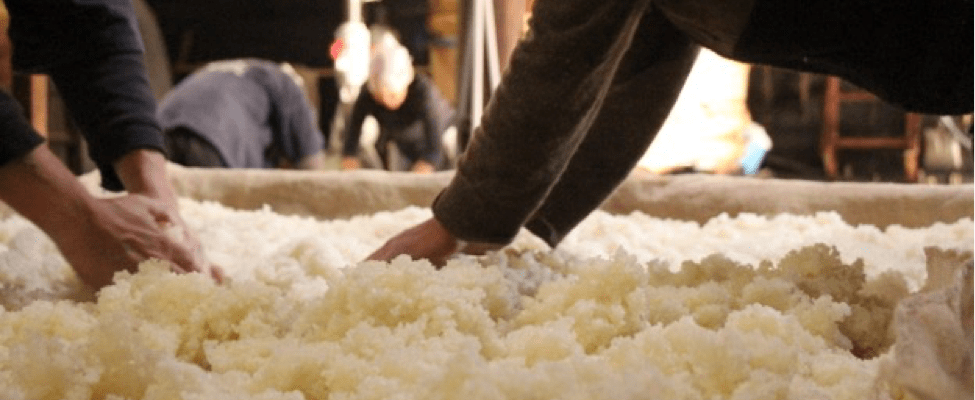
I based the book on data I collected during an ethnography at one of two natural sake breweries in Japan. By being there, in the flesh, working as a brewer with other brewers, I could pay attention to the brewing process, its environments, tools, rituals, seasonality, and artistry to study the more-than-human entanglements at the scale of a business venture. Uniquely, this brewery doesn’t add vials of yeast and bacteria like an ingredient, which means that the work of brewing entails perpetually creating conditions for the right ambient microbes to gather—and only certain microbes, at certain stages, in certain sequences. By taking into account this living world and its specificities, the brewers have to attune, adapt, and ascertain which microbes need what and when.
The brewers practice what I describes as an improvisational ethic that adapts to the unforeseen, which could offer a way to continue living with/in unknowable, multispecies worlds. With contributions to feminist theory, science and technology studies, and ethnographic writing, the book analyzes knowing enough, proprioception, uncertainty, the role of playfulness, our thermal futures, and microbial time.
Microbes and time; it doesn’t immediately ring a bell. But if we start to think about time in a more expansive sense—the pace, rhythms, cycles, durations, sequential orders, and so on—then the notion isn’t so far fetched. In the book, I write about polyrhythms and syncopations to better understand microbial life cycles synching up with ours. I didn’t set out to write about rhythms, music, and dance, but I ended up calling on my dance background more than I’d realised. The book is better for it.
More to come. For now, I’m ecstatic that something I’d been working on for years is finally crystallising before my very own eyes!
 Maya Hey